Executive Assistant Training
Setting the standard for the EA Profession
Through industry-leading certification, learning and recognition, we help Executive Assistants recognise the value they already create, communicate it with confidence, and consistently operate as trusted strategic partners.

Defining the Modern Executive Assistant Role
The Executive Assistant role has evolved far beyond traditional administrative support. Today’s EAs operate with judgement, influence and responsibility at executive level. They manage complexity, shape priorities, enable better decisions and create capacity across organisations.
Yet outdated perceptions persist; EAs are still too often seen as support staff, diary managers or “just an EA”, language that fails to reflect their true contribution and business impact.
The EA Institute exists to change that.
We set the standard for professional excellence in Executive Assistance, giving EAs the language, frameworks and confidence to recognise their capability, articulate their value and step fully into their impact. Our work strengthens the profession as a whole, so the contribution of Executive Assistants is understood, recognised and valued.
EAPC
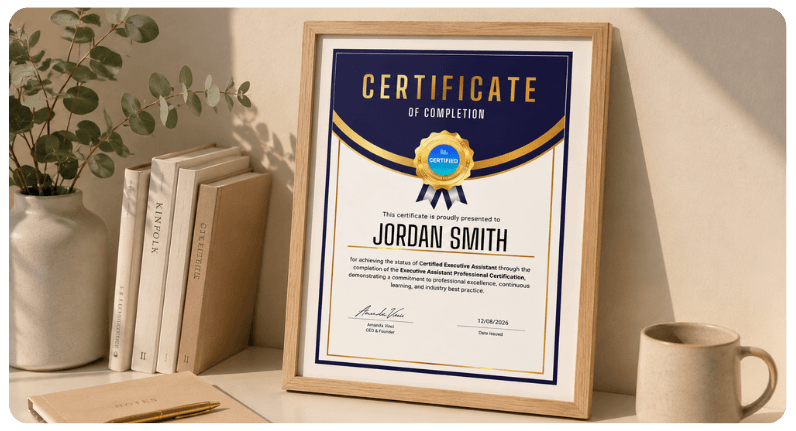
The Executive Assistant Professional Certification (EAPC) is our flagship certification for Executive Assistants who want to strengthen their capability, confidence and professional credibility.
It gives you a practical framework to build stronger executive partnerships, make better decisions, contribute more strategically, navigate AI with confidence and clearly communicate the value you bring.
You’ll develop your business acumen, judgement and influence, while earning a recognised certification that reflects your professional capability. You’ll also join a community of Executive Assistants committed to their development and raising the standard of the profession.
Wondering whether EAPC is right for you?















What EAs Say
I came to the realisation that I've instinctively been doing many of these things, but it's nice to have frameworks to refer back to to make sure I haven't miss any important steps and… and so on, and particularly if I'm planning a conversation. If it's on the fly, obviously, you kind of, you know, you're… you're in the moment and so on, but And I loved… just the created context, and just spending more time there, and I guess planning for possibility, really. Like, it's just spend less time in the, you know, in the actual, you know, the descriptive, kind of, language and so on, and get people out of that, and… which is what I have been doing, but it's just, yeah, it's having the language and the framework to put to things that I've kind of innately done.

I found the course really powerful because it challenged me to challenge myself in terms of my capabilities. Listening to the facilitator, hearing everyone else, and having the one-on-one conversations helped me realise that I am capable and I do have the ability, I just need to step up and believe in myself.

Coming into the course the second time, I expected a refresher—and it was—but it also gave me extra clarity and insight. The first time around it took a few sessions before the ‘pennies dropped’ and I realised how big it was, especially the internal reflection on why things haven’t progressed. This time, everything felt a lot clearer, and that added direction has been really beneficial.

I printed the leadership distinctions and put them up at my desk, and I’ve had quite a number of people stop and really take them in. It’s been great to see colleagues reflect on what they’re doing and then work it into their conversations and project work. Coming back to the course also reminded me how valuable it is to connect with other EAs—especially hearing experiences outside my organisation—and it’s already got me thinking about how I can keep changing how I work.


Meet Amanda
Amanda is on a mission to elevate the next generation of leaders, globally and holistically.
A former EA herself, Amanda rose from entry-level to supporting senior executives, ultimately establishing Australia’s premier training hub for Executive Assistants. With her flagship High Performing EA course and subsequent specialised courses, she has transformed the careers of hundreds of EAs by teaching them strategic mindset, leadership, and visibility skills essential for modern business.
An internationally accredited coach and keynote speaker, Amanda brings over a decade of experience in leadership, behavioural studies, and burnout prevention. She believes in empowering assistants to achieve their full potential and is dedicated to redefining the administration profession. Under Amanda’s leadership, The EA Institute continues to empower assistants to secure their voice and impact in business.
Follow Amanda on LinkedIn

FAQs
What is an Executive Assistant?
An Executive Assistant (EA) is a strategic support professional who enables leaders to operate effectively by managing priorities, filtering information, and applying judgement long before decisions reach the executive desk.At senior levels, the role goes beyond administration. Executive Assistants act as trusted partners; protecting focus, anticipating issues, and reducing friction across the business.At The EA Institute, we define the Executive Assistant role based on how it actually functions in modern executive environments, not outdated job descriptions.
What does an Executive Assistant do?
An Executive Assistant’s work is often invisible because, when done well, problems never surface.In practice, an Executive Assistant may:
- Decide what reaches the executive and what doesn’t
- Manage competing priorities across people, projects, and deadlines
- Anticipate risks, tensions, or breakdowns before they escalate
- Represent the executive’s intent, tone, and judgement in communication
- Protect focus by filtering noise, not just managing time
Much of this work never appears on a task list. Its value shows up as clarity, calm, and momentum for the executive and the organisation.
Is an Executive Assistant an administrative role?
The Executive Assistant role includes administration, but it is not limited to it.Senior Executive Assistants operate at a level that requires:
- Business judgement
- Context awareness
- Discretion and trust
- Decision-making under pressure
This is why the role is often misunderstood and why generic admin training rarely reflects the real work being done.
Why is the Executive Assistant role so often misunderstood?
Most organisations rely heavily on their Executive Assistants but lack a shared definition of what “good” actually looks like in the role.As a result:
- Capability is assumed rather than defined
- Expectations vary from leader to leader
- Praise replaces progression
- Development is inconsistent or misaligned
This gap between the written job description and the real job creates risk for organisations and frustration for EAs.
Why should organisations invest in Executive Assistant development?
Because a capable Executive Assistant directly improves executive effectiveness.When EAs are well-developed and aligned:
- Executives make better decisions
- Focus and time are protected
- Friction and escalation are reduced
- Dependency on individuals is replaced with capability standards
Investing in EA development is not a perk, it’s operational infrastructure.
Do you offer Executive Assistant training for organisations?
Yes. We work directly with organisations to deliver in-house Executive Assistant development and certification programs.These programs help organisations:
- Define clear EA capability standards
- Align expectations between executives, HR, and EAs
- Develop consistent, future-ready EA teams
- Strengthen executive–EA partnerships
Programs can be tailored for:
- Single executives and their EAs
- EA teams
- Organisation-wide capability uplift
What is the Executive Assistant Professional Certification?
The Executive Assistant Professional Certification (EAPC) is a future-focused, industry-validated qualification that defines and recognises executive-level EA capability.It brings together:
- Operational excellence
- Business judgement
- Leadership presence
- Modern AI fluency
When this certification appears on a CV, it acts as a shortcut to trust for executives, HR, and recruiters.
Is this certification suitable for experienced Executive Assistants?
Yes. The certification is designed for EAs who already carry responsibility and want their capability clearly recognised, articulated, and validated, not explained away.It is particularly valuable for EAs who are:
- Trusted but stretched
- Praised but not progressed
- Operating at executive level without formal recognition
Does your training include AI capability?
Yes. AI capability is a core and ongoing requirement across our programs.Executive Assistants are increasingly expected to understand and use AI tools responsibly and effectively. We treat AI fluency as a professional standard, not an optional extra.Separate to the EAPC, we also run Microsoft Copilot specific training throughout the year.
How do I know which program is right for me or my organisation?
If you’re an Executive Assistant, the certification provides clarity, confidence, and external recognition.If you’re an organisation, in-house development creates alignment, consistency, and stronger executive partnerships.We’re happy to help you determine the right path.
What is your refund or cancellation policy?
With the Executive Assistant Professional Certification (EAPC), our focus is on outcomes, not completion for completion’s sake.
If you do not leave the certification with clearer language for your capability, greater confidence, and stronger professional positioning than when you started, we will work with you until you do.
This certification is designed to create clarity and credibility. We stand behind that commitment.
Do you offer payment plans?
Yes. We offer Afterpay for online purchases under $2,000.
If you are enrolling in the Executive Assistant Professional Certification and would like to discuss alternative payment options, please talk to us about what may be available.